Renju — free online Board game
Five in a row with the classic forbidden moves for Black — the tournament form of gomoku.
Renju is the professional form of five in a row (gomoku), free to play in your browser against the computer or a friend. Take turns placing black and white stones on a 15×15 board; the first to line up five wins. Because the first player has a big advantage, Black opens on the centre point and may not make a double three, a double four or an overline of six or more — red marks show every forbidden point, and White can try to force Black onto one. Black wins only with exactly five, White with five or more. Switch to freestyle gomoku to play without restrictions. Three computer levels (the hardest searches for forced wins by continuous fours), play Black or White, two-player mode, undo and move numbers. No download, no sign-up.
Quick start
- Press Start. Choose a computer level (or 2 players), Renju or Freestyle rules, and whether you play Black or White.
- Tap an intersection to place your stone. Under Renju rules Black's first stone goes on the centre point, which blinks green.
- Line up five stones in a row — across, down or diagonally — before your opponent does.
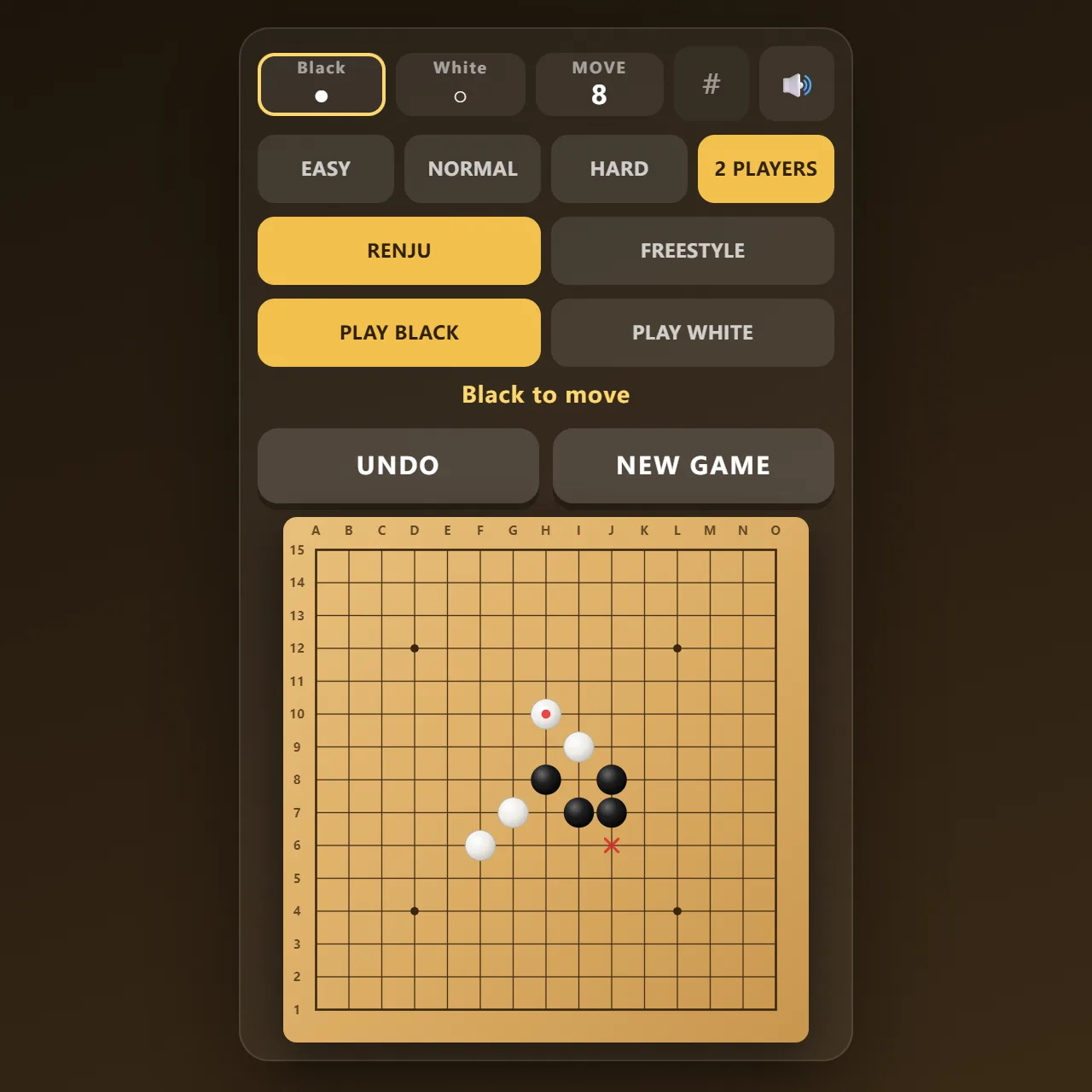
- Playing Black under Renju rules, avoid the points marked with a red ✕: they are forbidden moves.
How to play Renju
- The board is a 15×15 grid and stones go on the intersections. Black moves first; then the players alternate, one stone per turn. Stones never move once placed.
- The first player to make an unbroken line of five stones horizontally, vertically or diagonally wins. If the board fills up first, the game is drawn.
- Moving first is a large advantage in five in a row, so Renju restricts Black. Black's first stone must go on the centre point (H8).
- Black may not make a double three: one stone that creates two open threes at once (a three is open when one more stone can turn it into a four that is open at both ends).
- Black may not make a double four (one stone that creates two fours at once, even on the same line) or an overline (six or more in a row).
- Black wins only with exactly five. A stone that makes exactly five wins even if it would also be a double three or double four. White has no restrictions and also wins with six or more.
- In tournaments a forbidden move by Black loses at once; here the board simply refuses it and tells you why. White may still try to force Black into a position where the only defence is a forbidden point.
- Freestyle gomoku drops all of these rules: either colour may make any shape and five or more wins.
Renju terms
- Threeopen three
- Three stones in a line (with or without one gap) that one more stone turns into a straight four. If it is not blocked, it must be answered at once.
- Fourfour
- A line where one more stone makes five. A straight four (four in a row with both ends open) cannot be stopped.
- Double three3-3
- One move that makes two threes at once. Forbidden for Black under Renju rules.
- Double four4-4
- One move that makes two fours at once, in two lines or within one line. Forbidden for Black.
- Overline6+
- Six or more stones in a row. Forbidden for Black; a win for White.
- VCFwin by fours
- Victory by continuous fours: a series of fours, each forcing the reply, that ends in an unstoppable five. The hard computer looks for these.
Controls
- Place a stone: tap or click an intersection
- Undo: the Undo button or the U key (against the computer it takes back your move and its reply)
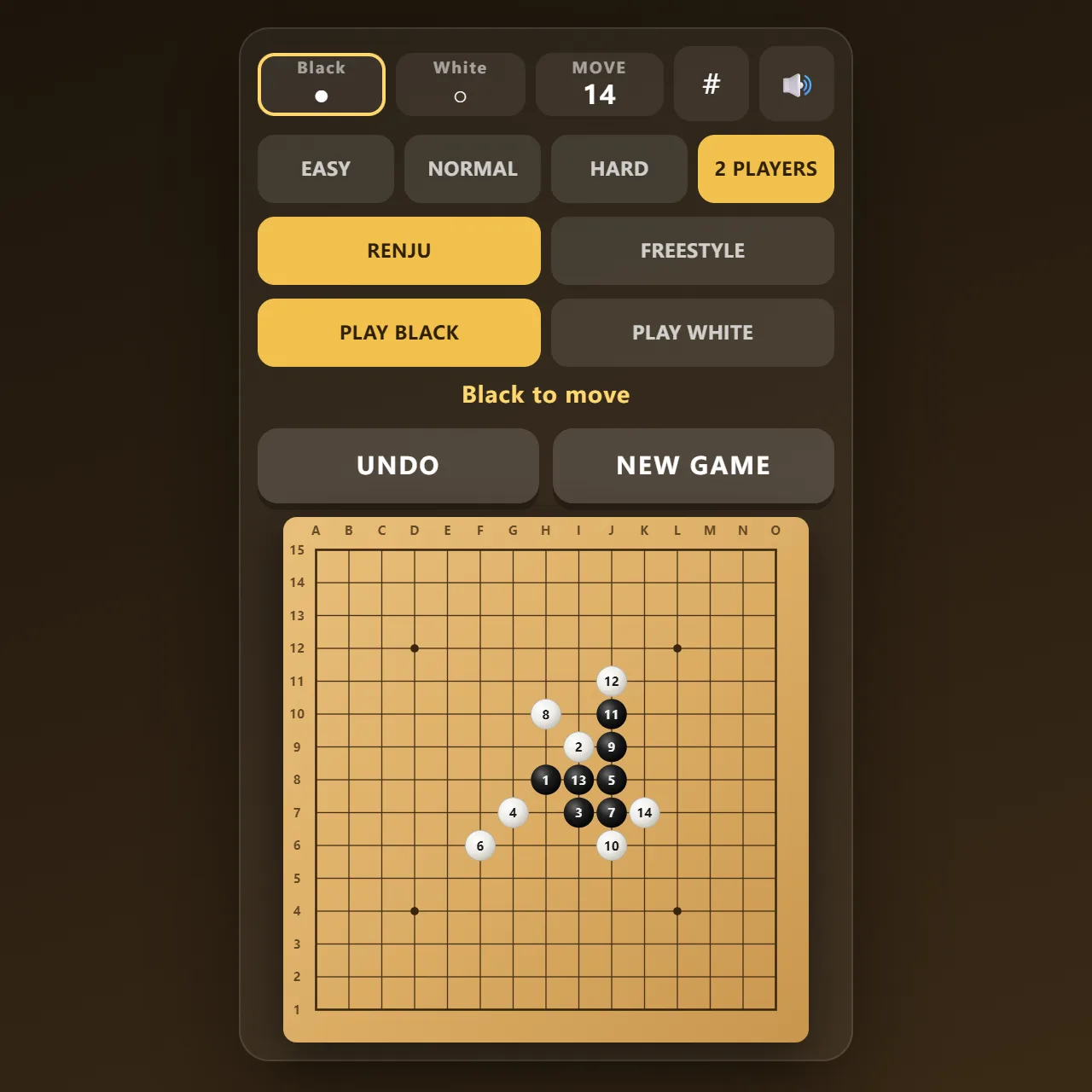
- #: show or hide the move numbers on the stones
- Level, rules and colour: the buttons in the side panel; changing them starts a new game
- After a win, View board closes the result so you can study the final position
Strategy tips
- Every open three demands an answer. Making a three and a four with one stone (a 4-3) wins, and it is allowed for Black.
- Block an open three at the end that also helps your own shape, not just the nearest point.
- As White, look at Black's red ✕ points: a threat whose only defence is a forbidden point wins for you.
- Play near the centre and near your own stones; stones on the edge build very few lines.
- Before blocking, check whether you have a four of your own — a four always moves first.
Frequently asked questions
What is the difference between Renju and Gomoku?
Gomoku is five in a row with few or no restrictions. Renju adds rules that restrict only Black (no double three, double four or overline, and the first stone on the centre) to balance Black's first-move advantage. Freestyle mode here plays plain gomoku.
Why can't I place a stone on a red ✕?
You are playing Black under Renju rules and that move would make a double three, a double four or six in a row. The message under the status line names the reason.
Does White ever have forbidden moves?
No. White may make any shape and also wins with six or more in a row.
How strong is the computer?
Easy plays loosely and sometimes misses your threats. Normal always takes a win, blocks fives and builds open fours. Hard also searches for wins by continuous fours and looks one reply ahead to avoid walking into yours.
Is Renju free?
Yes. It is completely free in your browser, with no download, no account and no in-game purchases.