Janggi — free online Board game
Korean chess: cannons that jump, palace diagonals and the bikjang showdown.
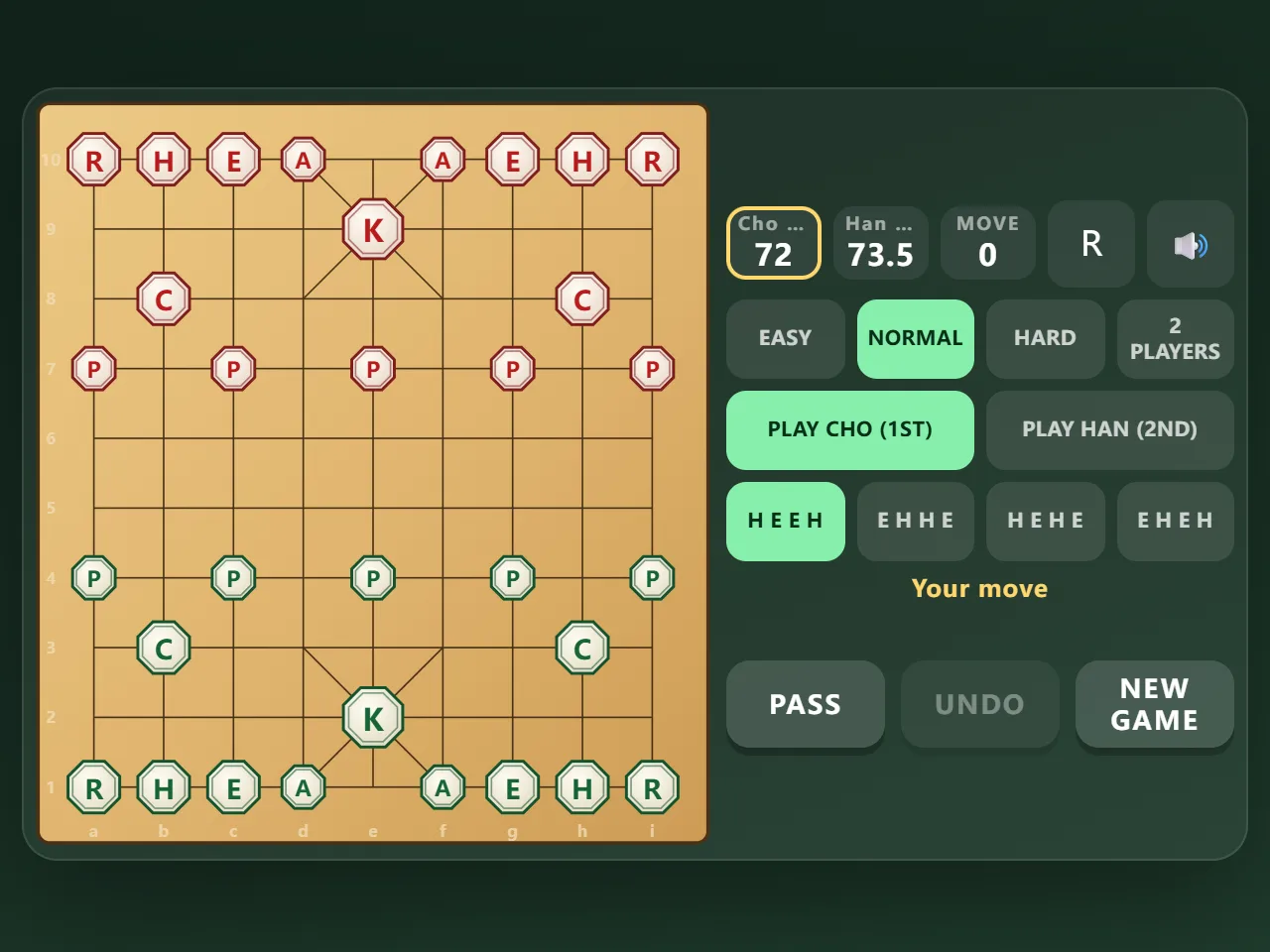
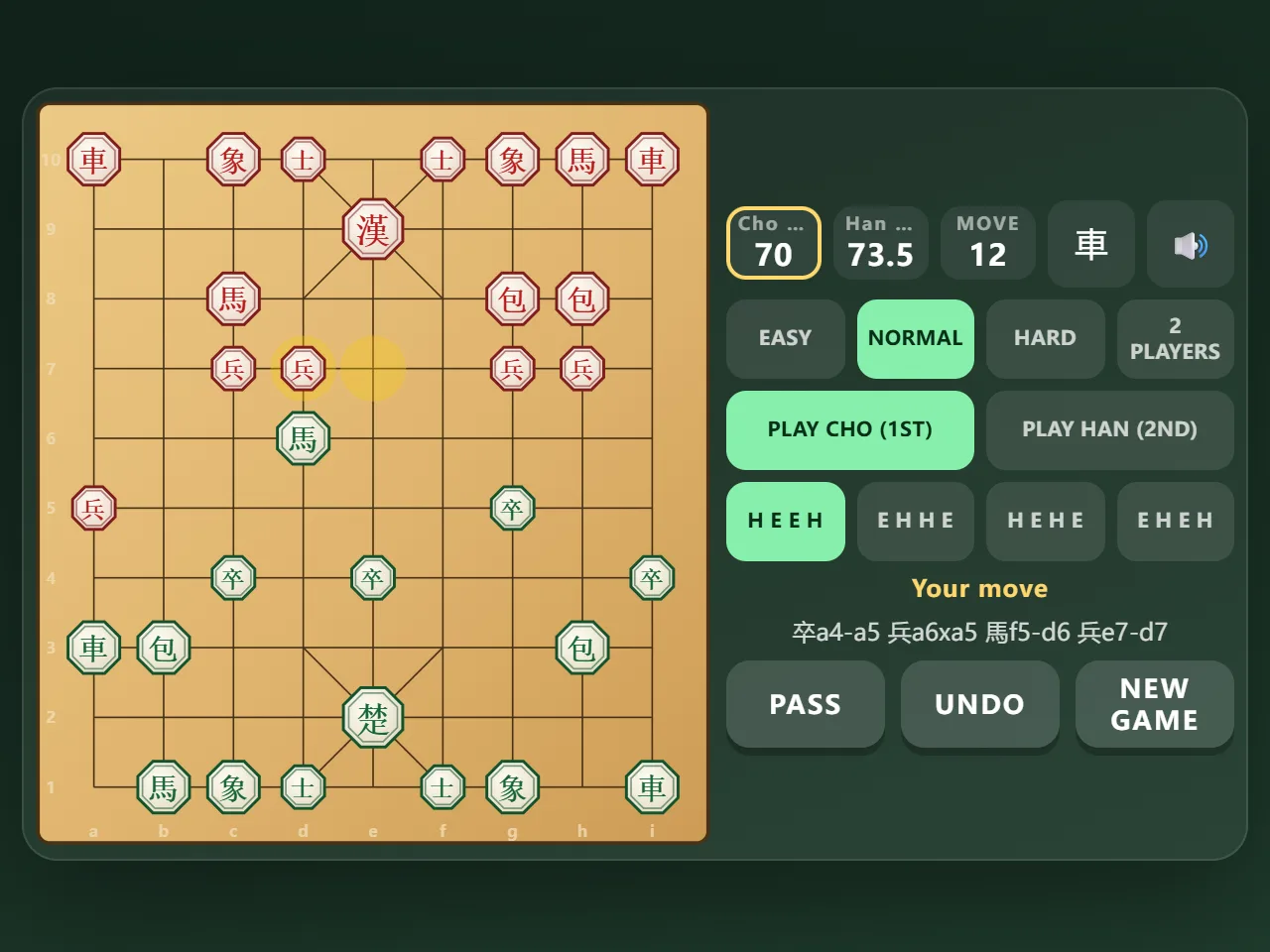
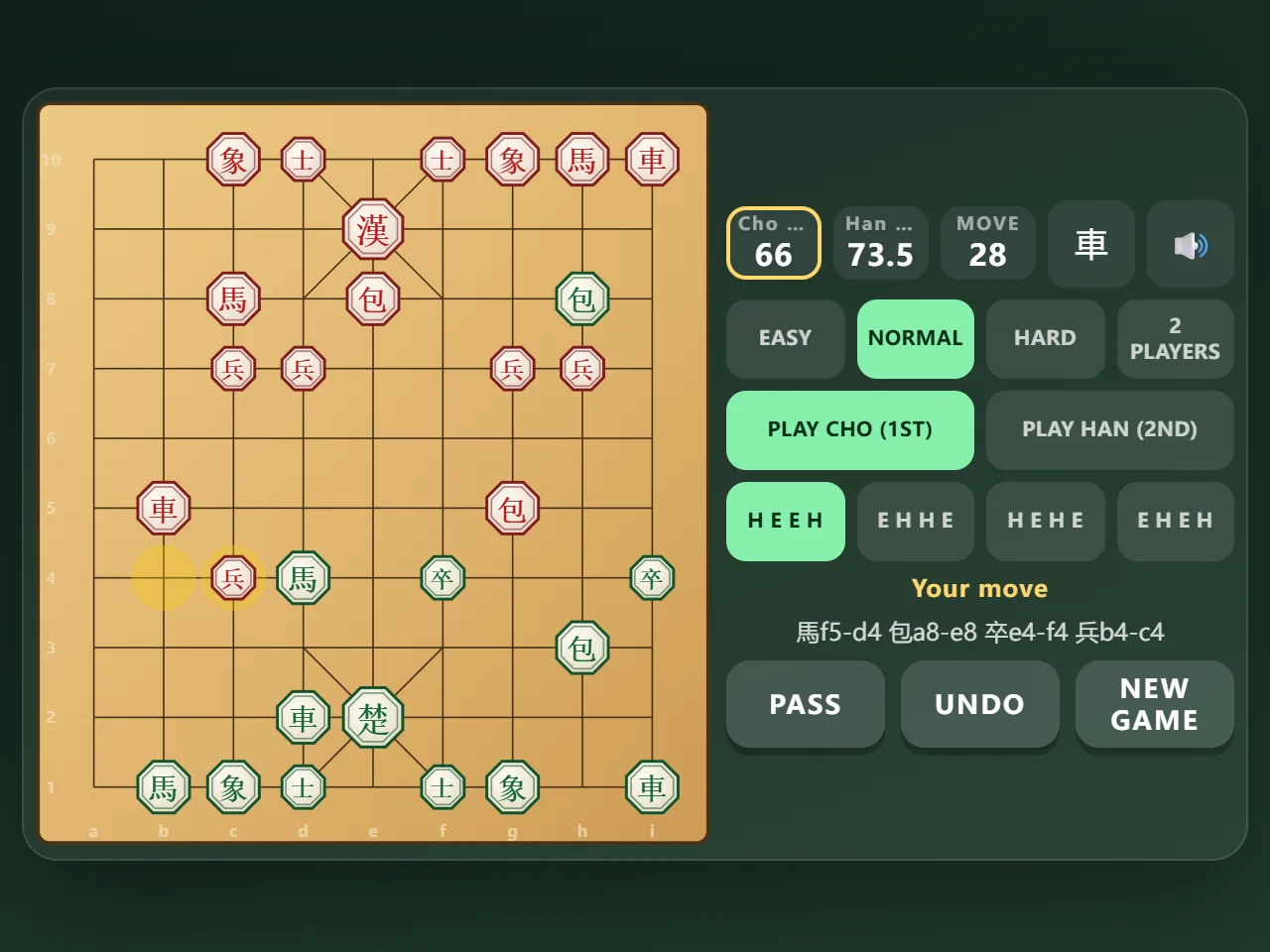
Janggi is Korean chess, free to play in your browser against the computer or a friend. Two armies — green Cho, who moves first, and red Han — face each other on a 9×10 grid, and you win by checkmating the enemy general inside its palace. It looks like Chinese chess, but plays very differently: there is no river, generals and guards move along the palace lines including the diagonals, elephants make a long three-step move, and cannons can only move or capture by jumping exactly one piece, never another cannon. Choose one of the four traditional horse and elephant set-ups, pass a turn when it helps, and watch for bikjang — when the two generals face each other on an open file, the game ends on points unless someone breaks it, with Han getting 1.5 points for moving second. Hanja or letter labels, three computer levels, two-player mode and undo. No download, no sign-up.
Quick start
- Press Start. Choose a level (or 2 players), whether you play Cho (green, first) or Han (red, second), and your horse–elephant set-up.
- Tap one of your pieces: green dots show where it can go; a ring marks a capture. Tap a dot to move.
- Use Pass when you have nothing useful to do (not while in check).
- Checkmate the enemy general inside its palace to win.
How to play Janggi
- Janggi is played on the points of a 9×10 grid. Each side has a palace — the 3×3 box marked with diagonals — where its general and two guards live. Cho (green) moves first.
- Each side has 16 pieces: a general, two guards, two chariots, two cannons, two horses, two elephants and five soldiers. Before the game each player chooses how to place the horses and elephants on the back row (four traditional set-ups).
- On your turn move one piece. Capture by moving onto an enemy piece. You must never leave your own general in check; if you are in check and cannot escape, you are checkmated.
- Instead of moving you may pass (hansu swim), as long as you are not in check.
- Bikjang: if the two generals face each other on the same file with nothing between, the next player must break it. If they make any other move, the game ends and is decided on points.
- Points: chariot 13, cannon 7, horse 5, elephant 3, guard 3, soldier 2. Han adds 1.5 points (deom) for moving second, so a points decision can never be a tie. The same count decides very long games.
The pieces
- General 楚 / 漢K
- One step along the lines of its palace, including the diagonal lines. Never leaves the palace.
- Guard 士A
- Moves exactly like the general and also stays in the palace.
- Chariot 車R
- Any distance along a file or rank, like a chess rook — and along the palace diagonals.
- Cannon 包C
- Moves along files, ranks or palace diagonals, but only by jumping exactly one piece (the screen), then landing on any empty point or capturing the first piece behind it. A cannon cannot jump over, or capture, another cannon.
- Horse 馬H
- One step straight, then one step diagonally outward. Blocked if the first point is occupied.
- Elephant 象E
- One step straight, then two steps diagonally outward. Blocked if either point on the way is occupied.
- Soldier 卒 / 兵P
- One step forward or sideways, never back. Inside the enemy palace it may also step diagonally forward along the palace lines.
Controls
- Move: tap a piece, then a green dot; tap the piece again to cancel
- Pass: the Pass button (disabled while you are in check)
- Undo: the Undo button or the U key (against the computer it takes back the computer's reply too)
- 車 / R button: switch the pieces between hanja and letters
- Keyboard: Enter lets the computer play a move for you
Strategy tips
- Cannons need screens: early on they are blocked by their own soldiers and horses. Moving a piece in front of a cannon can switch it on.
- Chariots are the strongest pieces — open the files for them and use the palace diagonals to attack the general.
- Keep your guards next to the general; the palace is small and a single chariot or cannon can trap it.
- When ahead on points, a bikjang can end the game in your favour. When behind, avoid letting the generals line up.
- Horses and elephants are easy to block — check what stands next to them before relying on them.
Frequently asked questions
How is janggi different from Chinese chess (xiangqi)?
There is no river, so elephants and soldiers can go anywhere; generals and guards move along the palace diagonals; elephants make a longer move; cannons need a screen even to move (not only to capture) and cannot use or take another cannon; you may pass; and facing generals (bikjang) is allowed but decides the game on points.
Why can't my cannon move?
A cannon always needs exactly one piece to jump over, and that piece cannot be a cannon. With nothing between it and the edge, or only a cannon, it has no move in that direction.
What is the 1.5 point deom?
Han moves second, so it gets 1.5 extra points whenever the game is decided on points (after bikjang or the move limit). The half point also rules out ties.
Which set-up should I choose?
All four are traditional. Horses on the inside (elephant–horse–horse–elephant) protect the centre; elephants on the inside attack it. Beginners often start with horse–elephant–elephant–horse.
Is Janggi free?
Yes. It is completely free in your browser, with no download, no account and no in-game purchases.