Shogi — free online Board game
Japanese chess with drops: captured pieces join your army. Full 9×9 shogi and 5×5 minishogi.
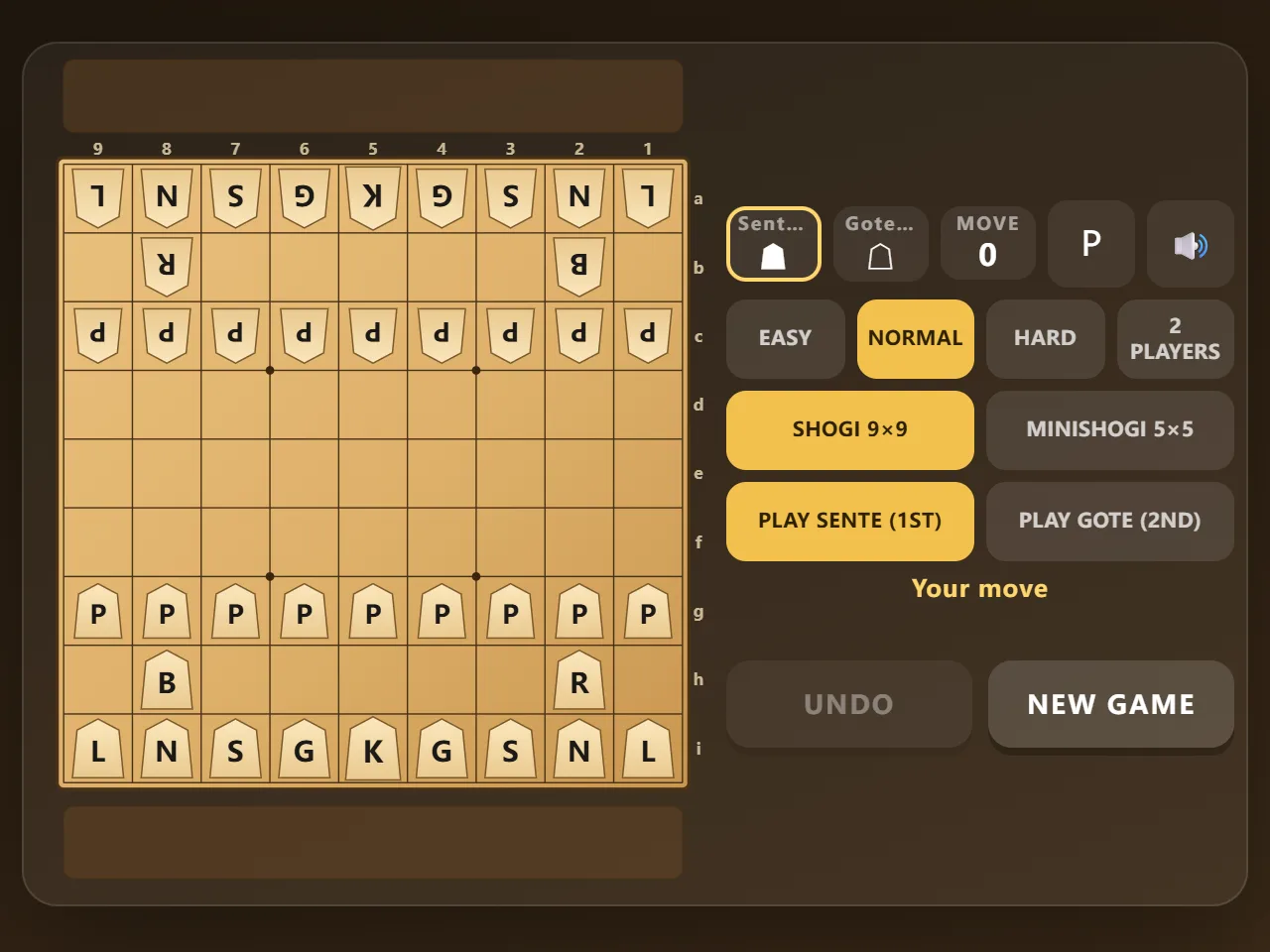
Shogi is Japanese chess, free to play in your browser against the computer or a friend. Like chess, you win by checkmating the enemy king, but every capture changes sides: a piece you take goes into your hand, and on a later turn you can drop it onto almost any empty square as your own. Pieces that enter the last three ranks may promote — a pawn becomes a gold general, the bishop a dragon horse, the rook a dragon king. The game enforces every rule, including the forbidden double pawn (nifu), no checkmate by a pawn drop and repetition (sennichite). Play full 9×9 shogi or 5×5 minishogi, a quick variant for beginners. Pieces can show traditional kanji or Western letters, moves are recorded in Japanese or Western notation, and you can play first (sente) or second (gote). Three computer levels, two-player mode and undo. No download, no sign-up.
Quick start
- Press Start. Choose a level (or 2 players), full shogi or 5×5 minishogi, and whether you play first (sente) or second (gote).
- Tap one of your pieces: green dots show where it can go. Tap a dot to move; a ring marks a capture.
- Captured pieces appear on your stand below the board. Tap one, then tap an empty square to drop it.
- When a piece reaches the last three ranks, choose Promote or Don't. Checkmate the enemy king to win.
How to play Shogi
- Shogi is played on a 9×9 board. Each side has 20 pieces that point toward the opponent; Sente moves first. All pieces are the same colour — ownership is shown by which way they face.
- On your turn, either move one piece or drop one piece from your hand. Pieces capture by moving onto an enemy piece; nothing jumps except the knight.
- A captured piece goes into the capturer's hand, unpromoted. Instead of moving, you may drop it on any empty square, facing the enemy, as your own piece.
- Drop restrictions: never two unpromoted pawns of yours on the same file (nifu); no pawn, lance or knight where it could never move again; and a pawn drop may not give an immediate checkmate.
- The last three ranks are the promotion zone. A piece that moves into, within or out of it may promote; pawns and lances on the last rank and knights on the last two must promote. Kings and golds never promote.
- You must never leave your own king in check. If the player to move has no legal move, they are checkmated and lose.
- If the same position (with the same pieces in hand and the same player to move) occurs four times, the game is a draw — unless one player gave check with every move of the cycle, in which case that player loses.
- Minishogi uses a 5×5 board with one king, gold, silver, bishop, rook and pawn per side, a one-rank promotion zone and the same drop rules.
The pieces
- King 玉 / 王K
- One step in any direction. Lose it and you lose the game.
- Rook 飛R
- Any distance straight up, down or sideways. Promotes to Dragon 龍, which can also step one square diagonally.
- Bishop 角B
- Any distance diagonally. Promotes to Horse 馬, which can also step one square straight.
- Gold general 金G
- One step straight in any direction or diagonally forward (six squares). Does not promote.
- Silver general 銀S
- One step diagonally in any direction or straight forward (five squares). Promotes to a gold mover 全.
- Knight 桂N
- Jumps two forward and one to the side — only forward. Promotes to a gold mover 圭.
- Lance 香L
- Any distance straight forward. Promotes to a gold mover 杏.
- Pawn 歩P
- One step straight forward, and captures the same way. Promotes to tokin と, a gold mover.
Controls
- Move: tap a piece, then a green dot; tap the piece again to cancel
- Drop: tap a piece on your stand, then an empty square
- Promotion: choose Promote or Don't when asked
- Undo: the Undo button or the U key (against the computer it takes back the computer's reply too)
- Keyboard: Enter lets the computer play a move for you
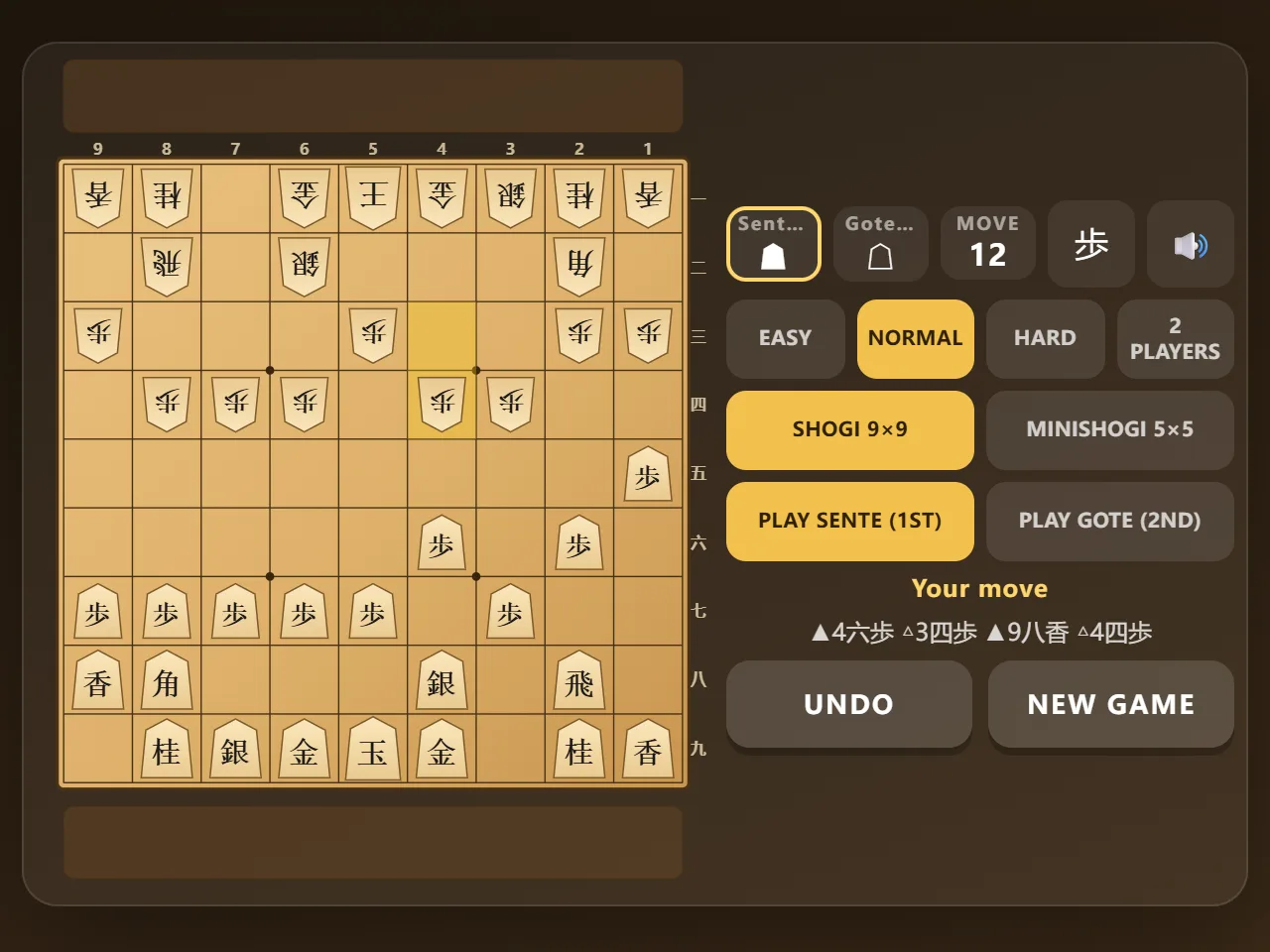
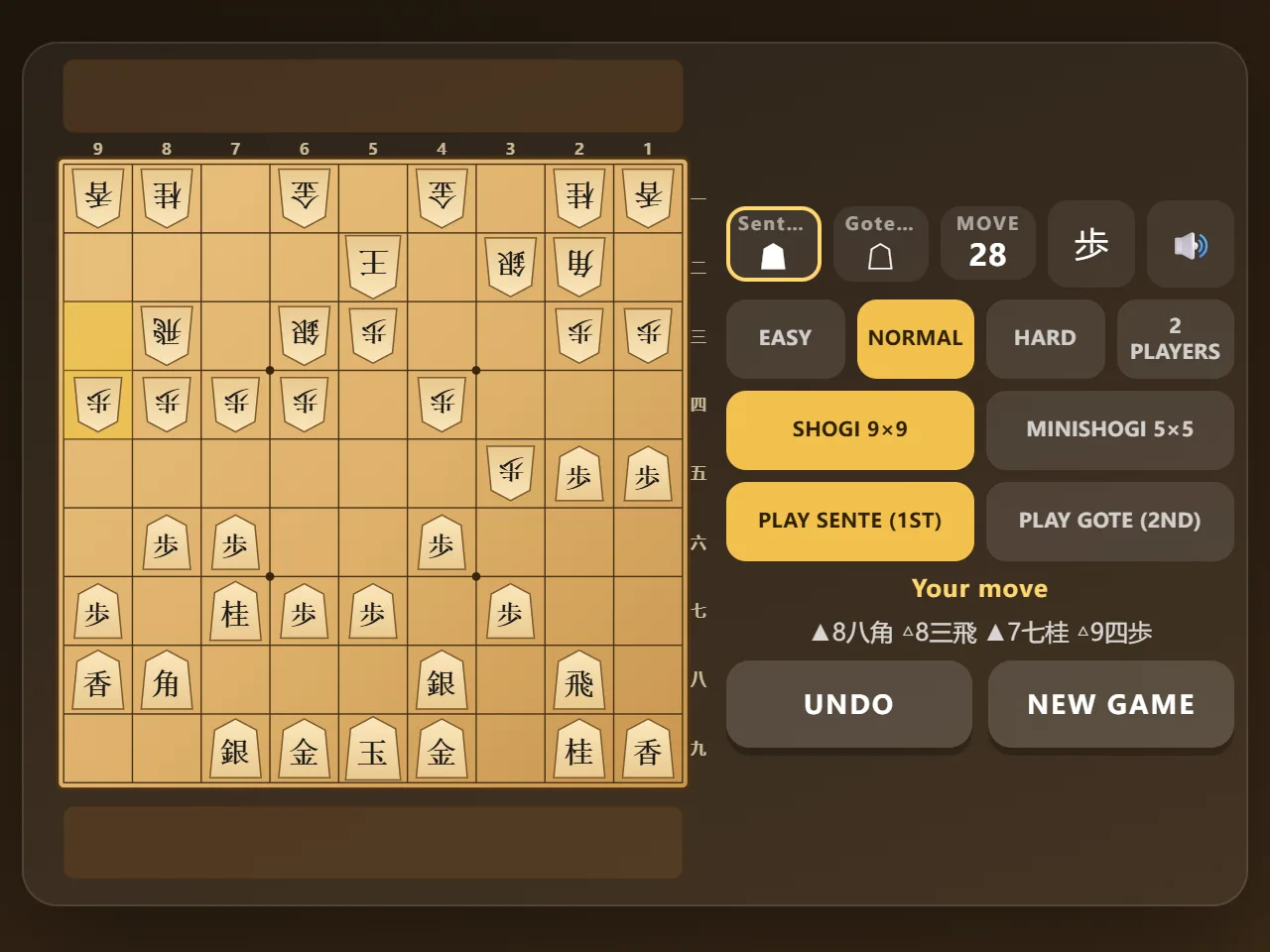
- 歩 / P button: switch the pieces between kanji and letters; the move list follows
Strategy tips
- Protect your king early: move it a few squares to the side and surround it with golds and silvers (a castle).
- A piece in hand is a threat everywhere. Trading pieces is not neutral as in chess — count what each side holds.
- Promoted pawns (tokin) are cheap and strong: if your opponent takes one, they only get a pawn back.
- Drops near the enemy king, especially golds and silvers, are how most games are won.
- Watch for forks by knights and lance pins along open files — both are easy to miss.
Frequently asked questions
What is the difference between shogi and chess?
The biggest one is drops: captured pieces come back into play for the captor. The board is 9×9, pieces promote in a three-rank zone, and there is no castling, no en passant and no queen.
Why can't I drop a pawn on that file?
You already have an unpromoted pawn on that file. Two pawns on one file (nifu) is illegal. Promoted pawns (tokin) do not count.
Why isn't my pawn drop allowed even though it gives check?
A pawn drop that checkmates immediately is forbidden (uchifuzume). Checkmating with a pawn that moves, or with a dropped piece of another type, is fine.
What is minishogi?
A 5×5 version (go-go shogi) with six pieces per side. Games are short and the rules are the same, which makes it a good way to learn drops and promotion.
Is Shogi free?
Yes. It is completely free in your browser, with no download, no account and no in-game purchases.