Koi-Koi — free online Card game
The classic hanafuda flower-card game: match the months, build yaku, and dare to call koi-koi.
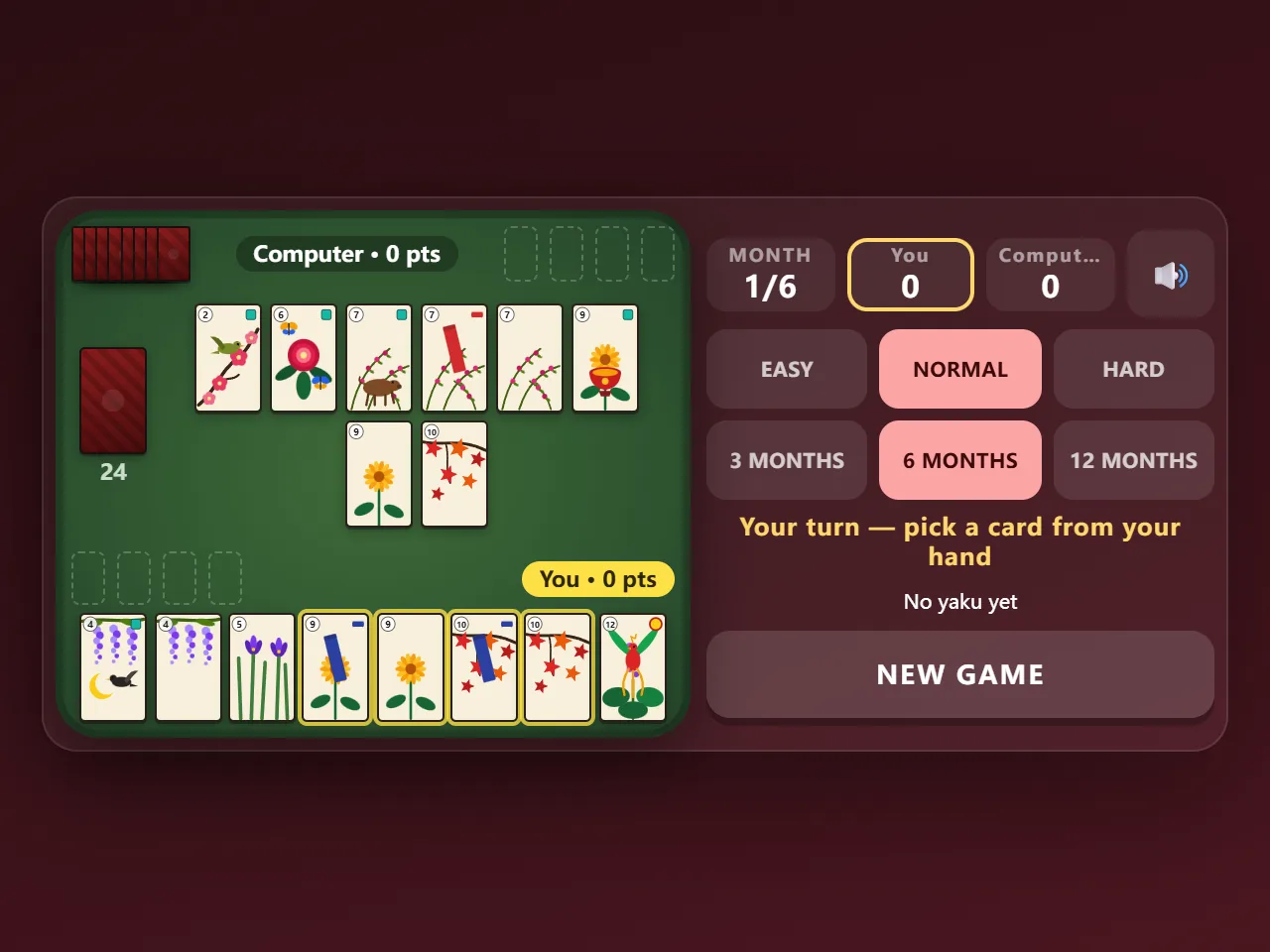
Koi-Koi is the most popular game played with hanafuda, the Japanese flower cards, free in your browser against the computer. The 48 cards show the twelve months of the year, four cards per flower. Play a card from your hand onto a card of the same flower to capture both, then turn over the top card of the deck and do the same. Collect yaku — sets such as the Five Brights, Boar-Deer-Butterfly, the poetry ribbons or flower-viewing sake. As soon as you make one, decide: stop and score, or call koi-koi and play on for a bigger hand, knowing that if your opponent completes a yaku first they score double. Seven points or more are doubled too. Play three, six or twelve months against three computer levels; the hardest simulates the rest of the round before every move. Every card shows its month number, so newcomers can match by number. No download, no sign-up.
Quick start
- Press Start, then pick a difficulty and how many months to play (3, 6 or 12).
- Tap a card in your hand. Cards on the table with the same flower — the same number in the corner — light up.
- Tap it again (or tap a lit card on the table) to capture the pair. With no match, tapping again lays it on the table.
- The top card of the deck is then turned over automatically and matched the same way.
- When your captured cards form a yaku, choose Stop to score or Koi-Koi to keep playing.
How to play Koi-Koi
- Hanafuda has 48 cards: twelve months, each shown by a flower or plant, four cards per month. The number in the top-left corner is the month.
- Each player gets eight cards and eight more are laid face up on the table; the rest form the deck. The dealer plays first, and the winner of a month deals the next one.
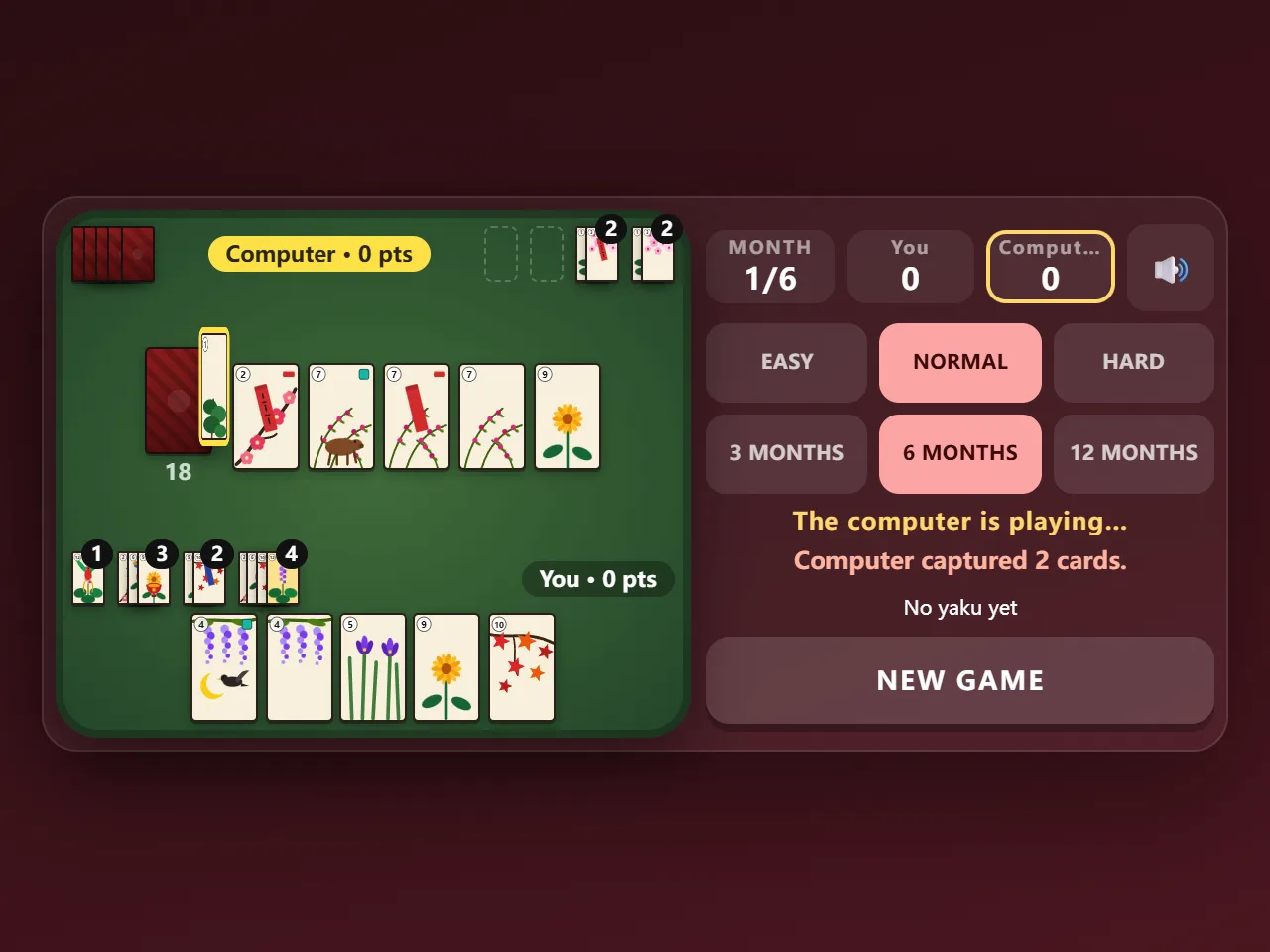
- On your turn, play one card from your hand. If a table card has the same month, take both. If two match, choose one; if three match, take all four. If none match, your card stays on the table.
- Then turn over the top card of the deck and do the same with it: capture a matching table card, or leave it on the table.
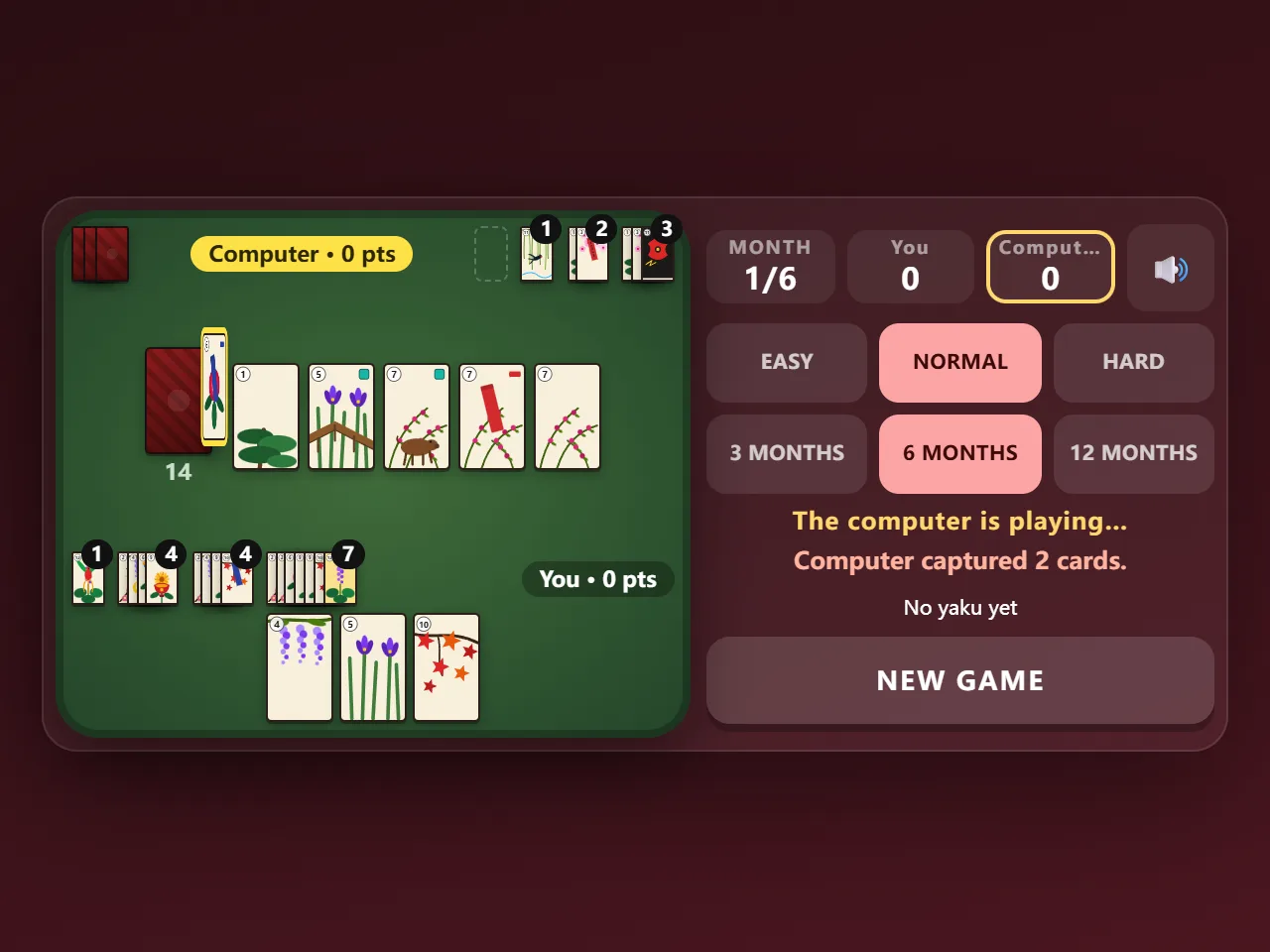
- Captured cards are what score. As soon as they form one or more yaku, or a bigger total than before, you choose: Stop (shōbu) ends the month and you score your yaku; Koi-Koi means you play on to improve your hand.
- If you call koi-koi and your opponent then makes a yaku and stops, they score double. A total of 7 points or more is also doubled. If both hands run out without anyone stopping, nobody scores that month.
- Hand yaku: if a player is dealt all four cards of one month, or four pairs, they score 6 points at once and the month ends.
- After the chosen number of months, the higher total wins.
Yaku (scoring sets)
- Five Brights10
- All five Bright cards: Crane, Curtain, Moon, Rain Man and Phoenix.
- Four Brights8
- Four Brights without the Rain Man.
- Rainy Four Brights7
- Four Brights including the Rain Man.
- Three Brights5
- Three Brights, not counting the Rain Man.
- Boar-Deer-Butterfly5
- The Boar (July), Deer (October) and Butterflies (June).
- Flower-Viewing Sake5
- The Cherry Curtain (March) and the Sake Cup (September).
- Moon-Viewing Sake5
- The Moon (August) and the Sake Cup.
- Poetry Ribbons5
- The three red ribbons with writing: January, February and March.
- Blue Ribbons5
- The three blue ribbons: June, September and October.
- Poetry & Blue Ribbons10
- All six of the above together (instead of 5 + 5).
- Animals1+
- Any five Animal cards, plus 1 point for each extra.
- Ribbons1+
- Any five Ribbon cards, plus 1 point for each extra.
- Chaff1+
- Any ten Chaff cards, plus 1 point for each extra. The Sake Cup also counts as chaff.
- Hand yaku6
- Dealt four cards of one month, or four pairs.
The twelve months
- 1 · PineBright
- Crane and Sun (Bright), poetry ribbon, two chaff.
- 2 · Plum blossomAnimal
- Bush warbler (Animal), poetry ribbon, two chaff.
- 3 · Cherry blossomBright
- Curtain (Bright), poetry ribbon, two chaff.
- 4 · WisteriaAnimal
- Cuckoo (Animal), red ribbon, two chaff.
- 5 · IrisAnimal
- Eight-plank bridge (Animal), red ribbon, two chaff.
- 6 · PeonyAnimal
- Butterflies (Animal), blue ribbon, two chaff.
- 7 · Bush cloverAnimal
- Boar (Animal), red ribbon, two chaff.
- 8 · Pampas grassBright
- Full moon (Bright), geese (Animal), two chaff.
- 9 · ChrysanthemumAnimal
- Sake cup (Animal, also counts as chaff), blue ribbon, two chaff.
- 10 · MapleAnimal
- Deer (Animal), blue ribbon, two chaff.
- 11 · WillowBright
- Rain Man with umbrella (Bright), swallow (Animal), red ribbon, lightning (chaff).
- 12 · PaulowniaBright
- Phoenix (Bright), three chaff.
Controls
- Play a card: tap it in your hand, then tap it again or tap a highlighted table card
- Two matches: tap the table card you want to take
- Koi-Koi or Stop: the two buttons that appear when you make a yaku (keyboard: K for koi-koi, Enter to stop)
- Keyboard: Enter plays a sensible card for you
- The corner marks show each card's class: gold circle = Bright, teal square = Animal, red or blue bar = Ribbon
Strategy tips
- Brights and the Sake Cup are worth taking whenever you can — the Sake Cup alone feeds two 5-point yaku.
- Watch what your opponent has captured. If they hold two of the Boar, Deer and Butterflies, grab the third first.
- When you must lay a card down, choose one whose other cards are already gone, so your opponent cannot take it.
- Call koi-koi early in the month when your hand is strong and your opponent is far from any yaku; stop when they are one card away.
- Seven points doubles your score: stopping at 6 is often worse than one more turn.
Frequently asked questions
What does "koi-koi" mean?
It means "come on!" — you are inviting more cards. Calling it keeps the month going so you can build a bigger score, at the risk of your opponent finishing a yaku first and scoring double.
Do I have to know the flowers?
No. Every card shows its month number in the corner, and cards you can match light up when you select a card from your hand.
Are these the official scoring rules?
Koi-koi has many house rules. This version uses the common Japanese scoring: 7 points or more are doubled, a koi-koi call by the loser doubles the winner's score, the Sake Cup also counts as chaff, and hand yaku score 6.
How is this different from Go-Stop?
Go-Stop is the Korean game played with the same 48 cards (hwatu). The cards and the idea of continuing ("go") are similar, but the scoring, the bonus rules and the number of players differ.
Is Koi-Koi free?
Yes. It is completely free in your browser, with no download, no account and no in-game purchases. Points have no money value.