Go-Stop — free online Card game
Korea's favourite flower-card game: match the months, reach seven points and call Go or Stop.
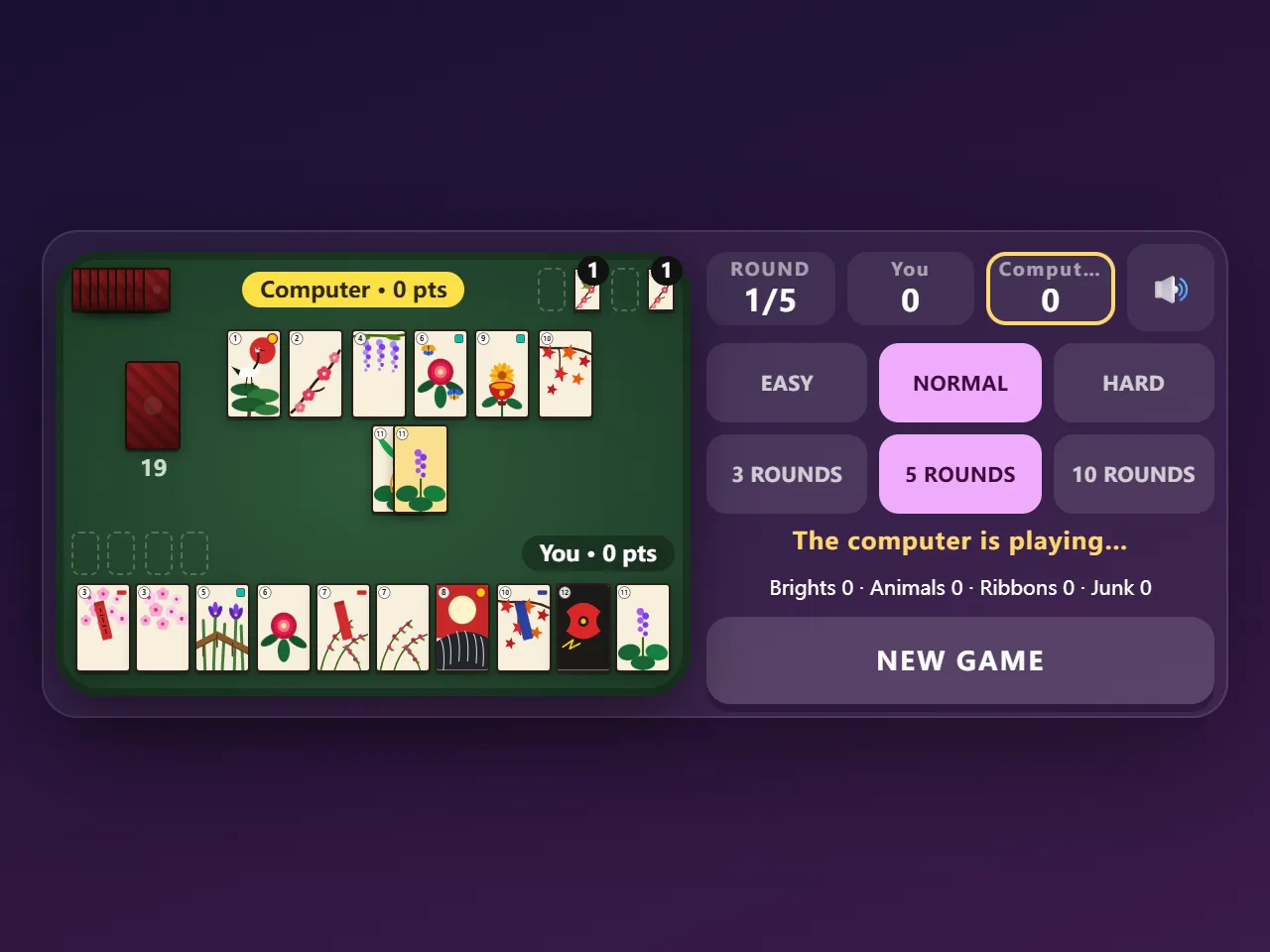
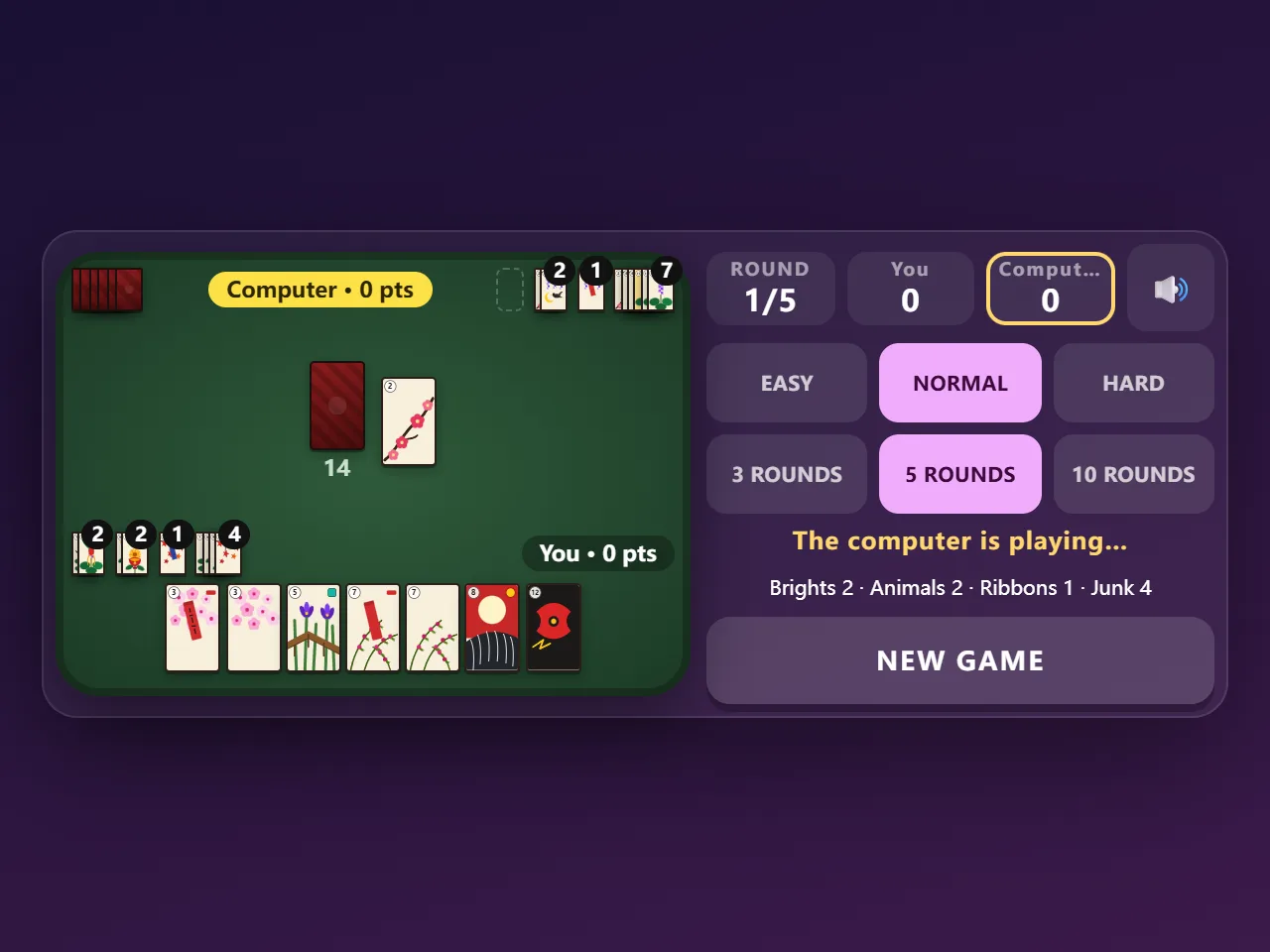
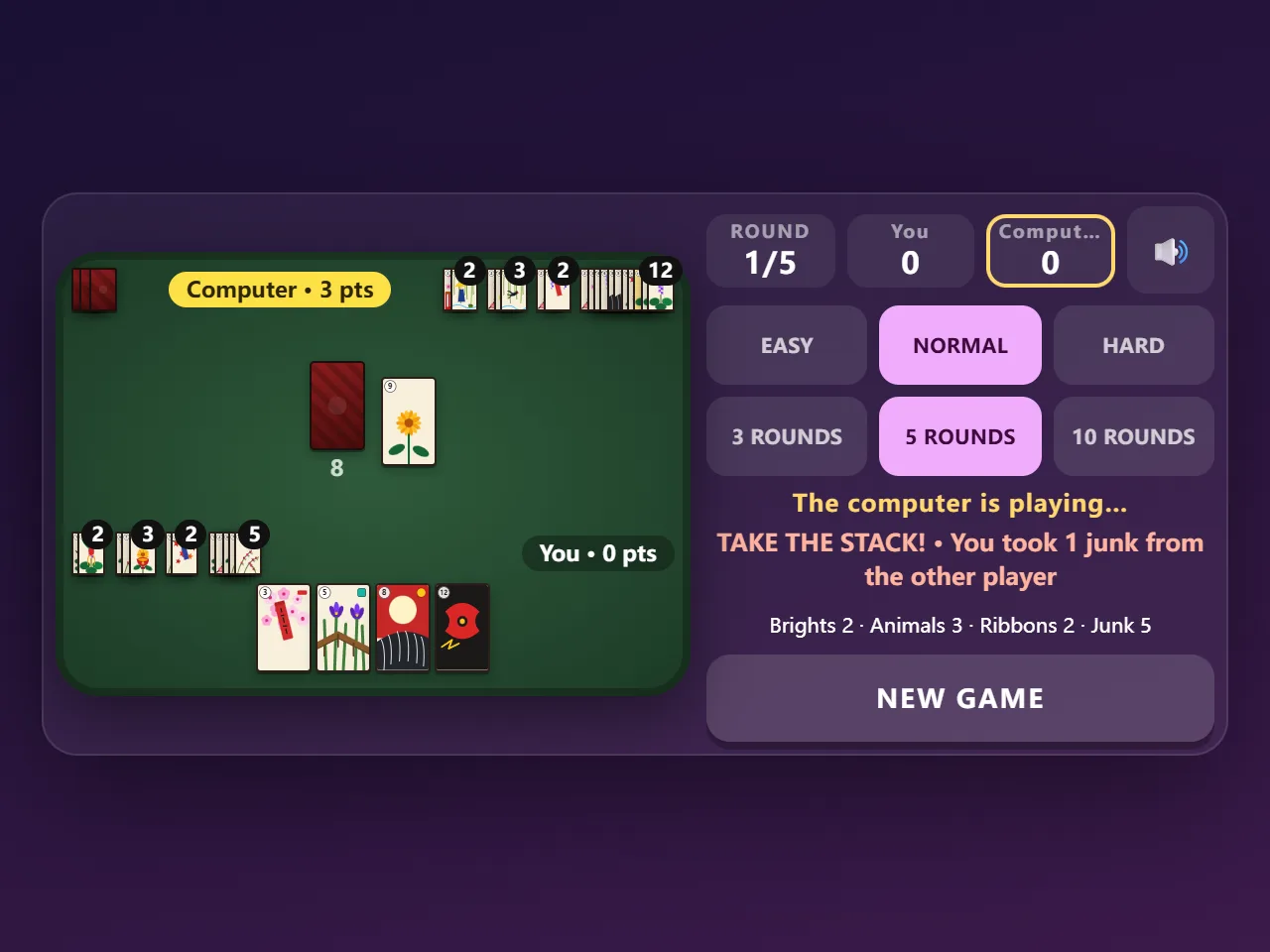
Go-Stop is the most popular card game in Korea, played with the 48 hwatu flower cards — here in its two-player form, matgo, free in your browser against the computer. Play a card onto a card of the same month to take both, then flip the top of the pile and match again. Score with brights, the three birds of godori, the red, blue and grass ribbons, animals and plenty of junk. Once you reach seven points you face the famous choice: Go to keep playing for more, or Stop and cash in — but if your opponent scores after your Go, you pay double. Every classic event is here: jjok, ppeok, ttadak, sweeping the floor, bombs, shaking and chongtong, plus the pibak, gwangbak, mungtta and gobak multipliers. Points only, no money and nothing to buy. Three computer levels; the hardest simulates the rest of the round before deciding Go or Stop. No download, no sign-up.
Quick start
- Press Start, pick a difficulty and how many rounds to play.
- Tap a card in your hand: floor cards of the same month (same number in the corner) light up. Tap again, or tap a lit floor card, to play it.
- The top of the pile is then flipped and matched automatically; if it matches two floor cards, tap the one you want.
- At 7 points choose Go (play on for more) or Stop (win the round now).
How to play Go-Stop
- Go-Stop uses the 48 hwatu cards: twelve months, four cards each. The number in the corner is the month; in Korea November is the paulownia and December the willow (rain).
- In matgo each player gets ten cards and eight go face up on the floor. On your turn play a card from your hand: if a floor card has the same month, take both; if two match, choose one; if three match, take all four. Otherwise your card stays on the floor.
- Then flip the top card of the pile and do the same with it. Special events can happen here — see the list below.
- Your captured cards score points. As soon as you reach 7 points (and each time your score rises after that) you choose: Stop ends the round and you are paid; Go means you keep playing for a bigger score.
- If you called Go and your opponent reaches 7 and stops first, you lose and pay double (gobak). If both players run out of cards and nobody has stopped, the round is a nagari: nobody scores and the next round counts double.
- The winner's score is the points plus the go bonus, multiplied by every bonus that applies (see Multipliers). After the chosen number of rounds the higher total wins.
Scoring
- Brights (gwang)3 / 4 / 15
- Three brights score 3 (only 2 if one of them is the rain bright of December), four score 4, all five score 15.
- Godori5
- The three bird cards: February's warbler, April's cuckoo and August's geese.
- Hongdan / Cheongdan / Chodan3 each
- The three red poem ribbons (Jan–Mar), the three blue ribbons (Jun, Sep, Oct) and the three grass ribbons (Apr, May, Jul).
- Animals (yeolkkeut)1+
- Five animal cards score 1, plus 1 for each extra.
- Ribbons (tti)1+
- Five ribbons score 1, plus 1 for each extra.
- Junk (pi)1+
- Ten junk score 1, plus 1 for each extra. The double junk of November and December counts as two, and the sake cup (gukjin) counts as an animal or as double junk, whichever scores more.
Special events
- Jjok+1 junk
- You lay down a card with no match and the flipped card is the same month: you take both and one junk from your opponent.
- Ppeokstuck
- You match one floor card and the flip is the third card of that month: all three stay stuck on the floor. Whoever plays the fourth takes them all and a junk.
- Ttadak+1 junk
- Two of a month on the floor, you play the third and flip the fourth: you take all four and a junk.
- Sweep (ssakssuri)+1 junk
- Your turn leaves the floor empty: take a junk from your opponent.
- Bomb (poktan)×2
- With three of a month in hand and the fourth on the floor, play all three at once to take the four, steal a junk and double your score. You then have two flip-only turns.
- Shake (heundeulgi)×2
- Hold three of a month while none is on the floor? Show them when you play one to double your score if you win.
- Chongtong10
- Dealt all four cards of a month: you win the round at once.
Multipliers
- Go+1 / +2 / ×2…
- One go adds 1 point, two goes add 2; from three goes the score doubles again with every go.
- Pibak×2
- You scored with junk and your opponent has fewer than six junk.
- Gwangbak×2
- You scored with brights and your opponent has none.
- Mungtta×2
- You hold seven or more animals.
- Gobak×2
- Your opponent had called Go and lost.
- Nagari×2
- The round after a nagari counts double (and keeps doubling until somebody wins).
Controls
- Play: tap a card in your hand, then tap it again or a glowing floor card
- Flip only: after a bomb, the Flip only button uses one of your two free turns
- Go / Stop and Shake: the buttons that appear when you can choose (keyboard: G for Go, Enter for Stop)
- Keyboard: Enter plays a sensible card for you
- The corner marks: gold circle = bright, teal square = animal, red or blue bar = ribbon; the junk pile shows its count with double junk counted twice
Frequently asked questions
What is matgo?
Matgo is two-player Go-Stop, the version most people play online. The full game is usually three players with three-point stops; matgo uses ten-card hands and a seven-point goal.
Is this gambling?
No. Go-Stop is often played for small stakes in Korea, but here there are only points: no money, no chips and nothing to buy.
How is Go-Stop different from Koi-Koi?
Both use the same flower cards and a 'keep going or stop' decision, but Go-Stop has different scoring (junk matters a lot), special events like ppeok and jjok, stealing junk, and multipliers such as pibak and gwangbak.
Why did my three brights only score 2?
Three brights that include the December rain bright score 2 instead of 3. Four or five brights score normally.
Is Go-Stop free?
Yes. It is completely free in your browser, with no download, no account and no in-game purchases.